
Fiat para birimleri
Kripto Paralar
Sonuç bulunamadı: ""
Aradığınız terimle eşleşen bir sonuç bulamadık. Farklı bir terimle tekrar deneyin.
Best Crypto Swap Exchanges in 2026: 10 Platforms for Swapping Crypto
Swapping one cryptocurrency for another should be quick, inexpensive, and straightforward. However, the cost of a crypto swap can vary significantly depending on which platform you use, the assets you're exchanging, and the liquidity available. Some exchanges also require you to deposit funds into their custody, while others let you trade directly from your cryptocurrency wallet.
Fortunately, there are plenty of crypto swap exchanges that cater to different needs. Centralized exchanges such as Binance and Kraken offer deep liquidity and convenient conversion tools, while decentralized platforms like Uniswap and Jupiter provide wallet-based trading without conventional account registration. In this article, we'll examine the 10 best crypto swap exchanges in 2026, including both centralized and decentralized options.
List of the best crypto swap exchanges in 2026
- Kraken – Best for secure cryptocurrency swaps and fiat integration
- KuCoin – Best for simple altcoin conversions with KuCoin Convert
- Binance – Best for deep liquidity and low trading fees
- PrimeXBT – Best for crypto swaps alongside multi-asset trading
- Uniswap – Best decentralized exchange for Ethereum-based tokens
- Jupiter – Best crypto swap aggregator on Solana
- NEAR Intents – Best for cross-chain swaps without manual bridging
- PancakeSwap – Best for low-cost token swaps on BNB Chain
- Coinbase Advanced – Best for advanced trading on an established US exchange
- 1inch – Best for finding competitive swap rates across decentralized exchanges
The 10 best crypto swap exchanges in 2026
The best crypto swap platform depends on the cryptocurrencies you want to exchange, whether you prefer centralized or decentralized trading, and how much you're willing to pay in fees.
Some platforms specialize in simple conversions, while others offer advanced trading features or aggregate liquidity across multiple exchanges. Let's take a closer look at the top crypto swap sites available in 2026.
1. Kraken – A secure and established exchange for cryptocurrency swaps
Kraken is one of the longest-running cryptocurrency exchanges, having launched in 2011. The platform has built a strong reputation for security and reliability, making it a popular choice for users who want to swap cryptocurrencies through an established centralized exchange.
Kraken supports more than 500 digital assets, including major cryptocurrencies such as Bitcoin, Ethereum, and XRP, alongside numerous smaller altcoins. Users can exchange cryptocurrencies through the standard Kraken interface or access more sophisticated trading functionality through Kraken Pro.
One of Kraken's biggest advantages is its liquidity. Popular cryptocurrency pairs generally have deep order books, which helps users execute trades at competitive prices and reduces slippage on larger transactions. The platform also supports fiat deposits and withdrawals, making it convenient for users who want to move between traditional currencies and crypto.
Kraken's simplified conversion feature is particularly useful for beginners who don't want to navigate order books or manually place trading orders. More experienced users can use Kraken Pro to access limit orders, advanced charts, and margin trading where available.
However, Kraken is a custodial exchange, meaning users must trust the platform to safeguard their deposited assets. The exchange also requires identity verification, and users should compare conversion quotes with Kraken Pro trading fees before executing larger swaps.
Pros:
- Long operating history and established security practices
- High liquidity on major cryptocurrency pairs
- Supports more than 500 digital assets
- Convenient fiat deposits and withdrawals
Cons:
- Requires KYC verification
- Custodial exchange introduces counterparty risk
- Simplified conversions can cost more than advanced spot trading
2. KuCoin – A user-friendly exchange with convenient altcoin conversions
KuCoin is a centralized cryptocurrency exchange best known for its extensive selection of altcoins. The platform supports hundreds of cryptocurrencies and provides several ways to exchange digital assets, including conventional spot trading and its dedicated KuCoin Convert feature.
KuCoin Convert allows users to swap between supported cryptocurrencies without navigating an order book. The service doesn't charge a separate trading fee, although the quoted exchange rate includes a spread. This makes it convenient for users who prioritize simplicity, but it doesn't necessarily mean that every conversion is cheaper than trading on the spot market.
The platform supports more than 150 cryptocurrencies through KuCoin Convert, covering many established digital assets and popular altcoins. It also offers limit orders for supported conversions, allowing users to specify their preferred exchange rate.
For traders who need more functionality, KuCoin provides conventional spot markets, futures, trading bots, and other cryptocurrency products. However, not every cryptocurrency available on the exchange can be swapped through KuCoin Convert.
Users should also be aware that KuCoin requires identity verification and is not available to US customers. The platform is therefore best suited for eligible international users who want a straightforward way to exchange a broad selection of cryptocurrencies.
Pros:
- No separate trading fee on KuCoin Convert
- Supports more than 150 cryptocurrencies for conversions
- Limit orders available for supported swaps
- Extensive altcoin selection on spot markets
Cons:
- Conversion rates include a spread
- Not available to US users
- Not every listed cryptocurrency is supported by KuCoin Convert
3. Binance – The best crypto swap exchange for deep liquidity

Binance is one of the largest cryptocurrency exchanges in the world by trading volume. The platform is particularly attractive for users who want to swap digital assets at competitive prices, thanks to its deep liquidity and extensive selection of supported cryptocurrencies.
Binance offers a dedicated feature called Binance Convert, which allows users to exchange cryptocurrencies through a simplified interface. Instead of placing orders on the spot market, users select the assets they want to exchange, enter an amount, and review the quoted conversion rate before confirming the transaction.
More experienced traders can use Binance's conventional spot markets, which generally offer competitive trading fees and advanced order types. The exchange's substantial liquidity can be particularly advantageous for users executing large swaps, as deeper order books tend to reduce slippage.
Binance also supports a broad selection of cryptocurrencies, including major assets such as Bitcoin, Ethereum, and Solana, alongside numerous smaller altcoins. Users can access additional features such as automated trading tools, futures, and earning products where available.
However, Binance has faced significant security challenges. On October 29, 2026, attackers reportedly stole approximately $6.3 billion in digital assets from the exchange's hot wallets. Binance subsequently announced measures to replenish affected funds and restore withdrawals, although the incident highlighted the risks associated with custodial trading platforms.
Binance's international platform is also unavailable to US residents, who must use alternative services such as Binance.US where eligible.
Pros:
- Deep liquidity across major cryptocurrency markets
- Competitive spot trading fees
- Convenient Binance Convert feature
- Broad selection of supported cryptocurrencies
Cons:
- Custodial platform introduces security and counterparty risks
- Major reported hot-wallet breach in October 2026
- International platform unavailable to US residents
4. PrimeXBT – A multi-asset platform with built-in cryptocurrency conversions
PrimeXBT is a trading platform that provides access to cryptocurrency derivatives alongside financial instruments linked to traditional markets. Although it primarily focuses on leveraged trading, PrimeXBT also offers a built-in exchange for converting between supported cryptocurrencies.
The platform's conversion feature allows users to exchange cryptocurrency balances without opening a derivatives position. This can be useful for traders who want to move between different digital assets while keeping their funds within the PrimeXBT ecosystem.
PrimeXBT also supports a broad selection of cryptocurrency futures and CFDs through its trading platforms. Users can access major markets such as BTC/USDT, ETH/USDT, and SOL/USDT, alongside numerous altcoins.
One of PrimeXBT's distinguishing features is its support for cross-asset trading instruments. Depending on the platform and jurisdiction, users can trade pairs such as BTC/XAU and BTC/EUR, providing exposure to cryptocurrency price movements relative to precious metals and fiat currencies.
However, users should distinguish between cryptocurrency swaps and derivatives trading. A swap involves converting one cryptocurrency balance into another, while a CFD or futures contract provides exposure to price movements without necessarily transferring ownership of the underlying asset.
PrimeXBT is therefore best suited for experienced traders who want straightforward cryptocurrency conversions alongside more sophisticated multi-asset trading functionality.
Pros:
- Built-in cryptocurrency conversion feature
- Access to crypto futures and CFDs
- Cross-asset trading instruments such as BTC/XAU
- Advanced trading platforms and charting tools
Cons:
- Smaller selection of assets for direct swaps than dedicated exchanges
- Primarily focused on derivatives trading
- Leveraged products involve substantial financial risk
5. Uniswap – The best decentralized exchange for Ethereum token swaps

Uniswap is one of the largest and most established decentralized cryptocurrency exchanges. Launched in 2018, the platform allows users to swap cryptocurrencies directly from their wallets without depositing funds into a centralized exchange account.
Unlike conventional exchanges that use order books, Uniswap relies on an automated market maker (AMM) model. Users exchange tokens through liquidity pools managed by smart contracts, while liquidity providers can earn a share of the trading fees generated by swaps.
One of Uniswap's biggest advantages is its extensive selection of supported tokens. Because the protocol is permissionless, new cryptocurrencies can become available for trading without approval from a centralized exchange operator.
Although Uniswap originated on Ethereum, it has expanded to numerous additional blockchain networks, including Arbitrum, Base, Optimism, Polygon, and BNB Chain. These networks can provide significantly lower transaction fees than Ethereum mainnet, making them attractive for smaller swaps.
Uniswap has also introduced Uniswap v4, which allows developers to create more customizable liquidity pools through a feature known as hooks. This expands the protocol's functionality beyond conventional AMM trading.
The main drawbacks are blockchain transaction fees and the risks associated with permissionless token listings. Users should verify token contract addresses carefully and be aware that Ethereum mainnet swaps can become expensive during periods of network congestion.
Pros:
- Swap tokens directly from a self-custodial wallet
- Extensive selection of cryptocurrencies
- Supports numerous blockchain networks
- No conventional account registration or KYC for basic swaps
Cons:
- Ethereum mainnet gas fees can be expensive
- Permissionless token listings increase exposure to scams
- Users must manage their own wallets and private keys
6. Jupiter – The best crypto swap aggregator on Solana

Jupiter is a decentralized exchange aggregator built around the Solana ecosystem. The platform has become one of the most popular ways to swap Solana-based tokens, thanks to its competitive execution rates and straightforward trading interface.
Unlike decentralized exchanges that rely primarily on their own liquidity pools, Jupiter searches liquidity across numerous Solana trading venues. When users initiate a swap, the platform identifies an efficient route for executing the transaction.
This approach can be particularly useful when trading cryptocurrencies whose liquidity is spread across multiple decentralized exchanges. Instead of relying on a single pool, Jupiter can route transactions through different venues to improve the effective exchange rate.
Jupiter also benefits from Solana's fast transaction processing and relatively low network fees. This makes it particularly suitable for users who frequently swap tokens or trade smaller amounts.
Beyond conventional swaps, Jupiter offers advanced trading functionality, including limit orders and dollar-cost averaging (DCA). These features make the platform more versatile than a basic decentralized exchange and provide users with additional control over their transactions.
However, Jupiter is primarily focused on the Solana ecosystem. Users looking to exchange tokens on Ethereum or BNB Chain may find other aggregators more convenient.
Pros:
- Aggregates liquidity from numerous Solana trading venues
- Competitive exchange rates
- Fast transactions and low network fees
- Advanced features such as limit orders and DCA
Cons:
- Primarily focused on Solana
- Newly launched tokens can be highly speculative
- Users must manage their own wallets
7. NEAR Intents – A cross-chain swap protocol that eliminates manual bridging
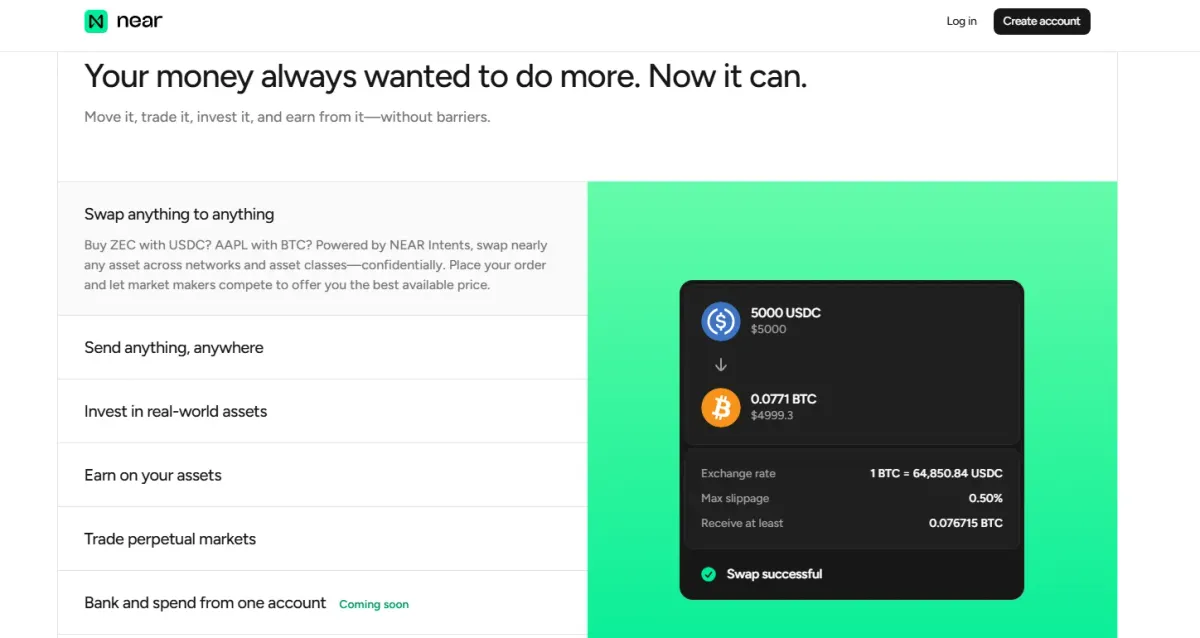
NEAR Intents is a cross-chain cryptocurrency swap protocol designed to simplify transactions between different blockchain networks. Instead of requiring users to manually bridge assets, the protocol allows them to specify the exchange they want to complete.
NEAR Intents uses an intent-based execution model. Users define the cryptocurrency they want to exchange and the asset they want to receive, while competing participants known as solvers attempt to fulfill the transaction.
This approach makes it possible to swap cryptocurrencies across networks that don't natively connect. For example, users can exchange USDT on Ethereum for SOL on Solana without manually bridging assets and performing separate transactions.
The protocol supports more than 35 blockchain networks and a broad selection of cryptocurrencies, making it particularly useful for users who frequently move assets between different ecosystems.
NEAR Intents also offers Confidential Intents, a feature designed to improve transaction privacy by limiting the public exposure of certain execution details.
However, users should understand that the settlement process introduces additional risks. Funds may be held within the protocol's settlement infrastructure while a swap is being completed, and the transaction depends on the system successfully delivering the destination asset or processing a refund.
For users who regularly exchange cryptocurrencies across different blockchain networks, NEAR Intents provides a convenient alternative to conventional bridging workflows.
Pros:
- Supports swaps across more than 35 blockchain networks
- No need to manually bridge assets in supported transactions
- Competitive solver-based execution
- Privacy-oriented functionality through Confidential Intents
Cons:
- Settlement introduces additional protocol risks
- Supported asset selection is smaller than on some single-chain DEXs
- Execution depends on solver availability and liquidity
8. PancakeSwap – The best decentralized exchange for low-cost BNB Chain swaps

PancakeSwap is one of the leading decentralized exchanges in the BNB Chain ecosystem. The platform allows users to exchange cryptocurrencies directly from their wallets through blockchain-based liquidity pools.
PancakeSwap is particularly popular among traders who want to swap BEP-20 tokens without paying the relatively high transaction fees sometimes associated with Ethereum mainnet trading.
Like Uniswap, PancakeSwap uses an automated market maker model to facilitate token swaps. Users connect a compatible wallet, select the assets they want to exchange, and authorize the transaction.
Although PancakeSwap is best known for its presence on BNB Chain, it also supports several additional blockchain networks, including Ethereum, Arbitrum, Base, and Solana.
The platform offers a range of features beyond basic token swaps, including liquidity provision, yield farming, staking, and perpetual futures trading. Its native CAKE token plays a role in the broader ecosystem.
PancakeSwap has also introduced PancakeSwap Infinity, an upgraded protocol that supports customizable liquidity pools through hooks. This provides additional flexibility for developers and liquidity providers.
The main advantage of PancakeSwap is its relatively low transaction costs on BNB Chain. However, users should be aware that liquidity can vary significantly between trading pairs and blockchain networks.
Pros:
- Low transaction fees on BNB Chain
- Extensive selection of BEP-20 tokens
- Supports multiple blockchain networks
- Additional DeFi and liquidity provision features
Cons:
- Liquidity can be thinner on networks outside BNB Chain
- Permissionless listings increase exposure to fraudulent tokens
- Users must manage their own wallets and transaction approvals
9. Coinbase Advanced – An established US exchange with professional trading tools
Coinbase Advanced is the advanced trading interface offered by Coinbase, one of the most established cryptocurrency exchanges in the United States.
While Coinbase's standard interface provides straightforward buying, selling, and conversion functionality, Coinbase Advanced is designed for users who want greater control over how their cryptocurrency trades are executed.
The platform supports hundreds of cryptocurrency trading pairs, including major assets such as Bitcoin and Ethereum alongside a selection of smaller altcoins.
One of Coinbase Advanced's biggest advantages is its liquidity. Popular trading pairs generally have substantial trading activity, helping users execute swaps efficiently through conventional market and limit orders.
Coinbase Advanced also uses a maker-taker fee model, with trading costs that depend on factors such as the user's trading volume and order type. For users who swap cryptocurrencies frequently, the Advanced interface can provide greater pricing transparency than simplified conversion tools.
The platform offers detailed price charts, technical indicators, and advanced order functionality. These features make it particularly attractive for traders who want a sophisticated experience without moving to a separate exchange.
However, Coinbase Advanced is still a centralized, custodial platform. Users must complete identity verification, and its trading fees may be relatively high for customers with low monthly trading volumes.
Pros:
- Established US-based cryptocurrency exchange
- Deep liquidity on major trading pairs
- Advanced order types and charting tools
- Integrated with the standard Coinbase account
Cons:
- Requires KYC verification
- Entry-level trading fees can be relatively high
- Custodial structure introduces counterparty risk
10. 1inch – A decentralized exchange aggregator for competitive swap rates

1inch is a decentralized exchange aggregator that helps users find competitive rates when swapping cryptocurrencies. Rather than relying on liquidity from a single decentralized exchange, the platform searches multiple sources and identifies efficient routes for executing transactions.
One of 1inch's most important features is its smart order routing technology. Depending on market conditions, the platform can split transactions across multiple liquidity pools to improve the effective exchange rate.
This can be especially useful when swapping larger amounts of cryptocurrency or trading tokens whose liquidity is spread across several decentralized exchanges.
1inch supports Ethereum and several additional blockchain networks, including BNB Chain, Base, Arbitrum, Polygon, and Solana. This provides users with access to a broad range of tokens and liquidity sources.
The platform also offers Fusion, an execution mechanism that allows professional resolvers to fulfill swaps. This can provide gasless execution from the user's perspective and help protect transactions against certain forms of maximal extractable value (MEV), such as front-running.
Fusion+ extends this functionality to supported cross-chain swaps, allowing users to exchange cryptocurrencies across different networks without relying on conventional bridging workflows.
However, 1inch can be more complex for beginners than a basic token swap interface. Users should also consider network fees, execution times, and the total amount they'll receive before confirming a transaction.
Pros:
- Aggregates liquidity across multiple decentralized exchanges
- Smart routing can improve swap execution
- Supports multiple blockchain networks
- Fusion offers gasless and MEV-protected execution for eligible swaps
Cons:
- Interface can be more complex for beginners
- Some execution methods may take longer to complete
- Network fees can make small swaps expensive
How to choose the best crypto swap exchange
Choosing the right crypto swap exchange depends on several factors, including the cryptocurrencies you want to trade, the blockchain networks you're using, and whether you prefer a centralized or decentralized platform.
Here's a quick comparison of the exchanges covered in this article:
| Exchange | Best for | Platform type |
| Kraken | Secure swaps and fiat integration | Centralized exchange |
| KuCoin | Simple altcoin conversions | Centralized exchange |
| Binance | Deep liquidity and low trading fees | Centralized exchange |
| PrimeXBT | Crypto conversions and multi-asset trading | Centralized trading platform |
| Uniswap | Ethereum and multi-chain token swaps | Decentralized exchange |
| Jupiter | Solana token swaps | DEX aggregator |
| NEAR Intents | Cross-chain swaps | Intent-based protocol |
| PancakeSwap | Low-cost BNB Chain swaps | Decentralized exchange |
| Coinbase Advanced | Advanced trading on an established US exchange | Centralized exchange |
| 1inch | Aggregated liquidity and efficient routing | DEX aggregator |
For beginners, centralized exchanges such as Kraken and Binance provide convenient conversion tools that don't require users to manage liquidity pools or blockchain transaction approvals.
Users who already hold their cryptocurrency in self-custodial wallets may prefer decentralized platforms. Uniswap is particularly suitable for Ethereum-based tokens, while Jupiter is a strong option for Solana assets.
For swaps between different blockchain networks, NEAR Intents and 1inch offer alternatives to manually bridging assets and trading them on separate exchanges.
What is a crypto swap exchange?
A crypto swap exchange is a platform that allows users to convert one cryptocurrency directly into another. For example, a user might exchange Bitcoin for Ethereum, swap USDT for USDC, or convert a smaller altcoin into a more established cryptocurrency.
Crypto swaps can be executed through several different mechanisms.
- Centralized exchange conversions: Platforms such as Binance and KuCoin offer conversion tools that allow users to exchange cryptocurrencies through their exchange accounts. These services generally require users to deposit funds into the platform's custody.
- Decentralized exchange swaps: Platforms such as Uniswap and PancakeSwap use smart contracts and liquidity pools to facilitate transactions directly from users' cryptocurrency wallets.
- DEX aggregators: Platforms such as Jupiter and 1inch search multiple decentralized exchanges to identify competitive execution routes.
- Cross-chain swap protocols: Services such as NEAR Intents facilitate exchanges between cryptocurrencies on different blockchain networks, often without requiring users to bridge assets manually.
Each approach offers different advantages in terms of convenience, fees, custody, and supported cryptocurrencies.
Centralized vs. decentralized crypto swap exchanges
One of the most important decisions when choosing a crypto swap platform is whether to use a centralized exchange (CEX) or a decentralized exchange (DEX).
Centralized exchanges generally provide a more familiar trading experience. Users create an account, deposit cryptocurrency, and complete conversions through the platform's trading interface.
These exchanges often offer strong liquidity, customer support, and fiat payment options. However, they also require users to trust the platform with their deposited funds and typically enforce identity verification requirements.
Decentralized exchanges allow users to trade through blockchain-based smart contracts. Instead of depositing funds into an exchange account, users connect a compatible cryptocurrency wallet and authorize individual transactions.
This approach gives users greater control over their assets and generally eliminates the need for conventional account registration. However, users must manage their own private keys and understand blockchain transaction fees.
Neither approach is universally better. Centralized exchanges may be more convenient for beginners, while decentralized platforms are often preferable for users who want to maintain self-custody of their cryptocurrency.
How much do crypto swaps cost?
Crypto swap fees vary depending on the platform, the cryptocurrencies being exchanged, and the blockchain network involved.
On centralized exchanges, users may pay a conventional trading fee or receive a conversion quote that incorporates the exchange's spread. Some platforms advertise zero-fee conversions, but this doesn't necessarily mean the transaction is free, since the exchange rate may differ from the prevailing market price.
On decentralized exchanges, users generally pay trading fees associated with liquidity pools as well as blockchain transaction fees.
For example, swapping tokens on Ethereum mainnet can become expensive during periods of network congestion. Networks such as Solana, BNB Chain, and Ethereum layer-2 solutions typically offer lower transaction costs.
Slippage is another important consideration. It refers to the difference between the expected exchange rate and the price at which a transaction is actually executed. Swaps involving illiquid tokens or large transaction amounts can experience significant slippage.
When comparing crypto swap platforms, users should consider the total amount of cryptocurrency they will receive after accounting for spreads, trading fees, network costs, and potential slippage.
Can you swap crypto without KYC?
Yes, some cryptocurrency swap platforms allow users to exchange digital assets without completing conventional identity verification.
Decentralized exchanges such as Uniswap, PancakeSwap, Jupiter, and 1inch generally allow users to connect a compatible wallet and trade without opening a conventional exchange account.
However, no-KYC trading doesn't necessarily mean that transactions are anonymous. Blockchain activity is typically recorded on public ledgers, and wallet addresses can potentially be linked to real-world identities.
Centralized exchanges generally have stricter verification requirements. Platforms such as Kraken, Binance, KuCoin, and Coinbase require users to complete identity verification to access their trading services.
For a more detailed overview of platforms with limited identity verification requirements, check out our guide to the best anonymous (no-KYC) crypto exchanges.
What are the risks of using crypto swap exchanges?
Although crypto swap exchanges make trading more convenient, users should be aware of several risks before transferring funds.
- Exchange security: Centralized exchanges can experience hacks, account freezes, or operational failures. Users should avoid keeping more cryptocurrency on custodial platforms than necessary for trading.
- Fraudulent tokens: Decentralized exchanges often support permissionless token listings, meaning scammers can create tokens that imitate legitimate projects. Always verify token contract addresses through official sources.
- Slippage and transaction fees: Swaps involving illiquid assets can result in significantly worse execution prices than expected. Users should review slippage settings and total transaction costs before confirming trades.
- Cross-chain risks: Moving assets between different blockchain networks introduces additional technical complexity. Bridges and intent-based protocols rely on settlement mechanisms that can fail or experience delays.
- Wallet security: Users trading through decentralized exchanges are responsible for safeguarding their private keys and approving smart contract interactions. Malicious approvals can expose wallet funds to theft.
Testing an unfamiliar platform with a small transaction can help users understand its interface and settlement process before committing larger amounts.
The bottom line
The best crypto swap exchange ultimately depends on where your assets are held, which cryptocurrencies you want to exchange, and how much control you want over the trading process.
For users who prioritize liquidity, security, and convenience, Kraken and Binance are among the strongest centralized options. KuCoin is particularly attractive for altcoin conversions, while Coinbase Advanced provides professional trading tools within an established US exchange.
On the decentralized side, Uniswap remains one of the leading platforms for Ethereum-based token swaps, while Jupiter is particularly well-suited for users trading within the Solana ecosystem. PancakeSwap offers inexpensive swaps on BNB Chain, and 1inch can help users access competitive rates across multiple liquidity sources.
For users who regularly move assets between different blockchain networks, NEAR Intents offers an alternative to conventional bridging workflows through its intent-based execution model.
Ultimately, the best platform is the one that supports your preferred cryptocurrencies, offers competitive total transaction costs, and provides the level of convenience and control you're looking for. Before completing a swap, always verify the destination network, compare the amount you'll receive, and make sure you're using the platform's official website.
Frequently asked questions
What is the best crypto swap exchange without KYC?
Decentralized exchanges such as Uniswap, Jupiter, PancakeSwap, and 1inch generally allow users to swap cryptocurrencies directly from their wallets without completing conventional KYC verification.
However, blockchain transactions remain publicly traceable, and access restrictions may apply depending on the platform and jurisdiction.
Why do crypto swap fees vary between platforms?
The total cost of a cryptocurrency swap depends on several factors, including trading fees, exchange spreads, blockchain transaction costs, and slippage.
DEX aggregators such as Jupiter and 1inch can sometimes reduce execution costs by routing transactions across multiple liquidity sources. However, a platform advertising zero trading fees isn't necessarily the cheapest option if its exchange rate includes a substantial spread.
How long does a cryptocurrency swap take?
On centralized exchanges, cryptocurrency conversions are generally completed almost instantly because transactions occur within the exchange's internal system.
On decentralized exchanges, settlement times depend on the blockchain network. Swaps on Solana and BNB Chain typically confirm quickly, while Ethereum mainnet transactions can take longer during periods of congestion.
Cross-chain swaps may take several minutes or longer, depending on the networks and settlement mechanisms involved.
Are cryptocurrency swaps taxable?
In many jurisdictions, including the United States and the United Kingdom, exchanging one cryptocurrency for another can trigger a taxable event, even if the assets are never converted into fiat currency.
Tax treatment varies by country, so users should keep records of their transactions and consult the applicable local regulations.
Bizi bulun:
X (Twitter) | Telegram | Reddit
CoinCarp Uygulamasını Şimdi İndirin: https://www.coincarp.com/app/