
Fiat-Währungen
Kryptowährungen
Keine Ergebnisse für ""
Wir konnten nichts finden, das zu Deiner Suche passt.Versuche es noch einmal mit einem anderen Begriff.
Bitcoin Is the Backup System: Scott Stornetta on Decentralization, Immutability, and Blockchain's Invisible Future
As digital assets mature, much of the public discourse around Bitcoin remains anchored in price movements, speculation, and market cycles. Yet this framing often overlooks the more fundamental question; what problem Bitcoin actually solves at the infrastructure level.
That distinction became clear in a discussion between senior banking executives and Scott Stornetta, whose early work on cryptographic timestamping is directly cited in the Bitcoin whitepaper. During an interview with Binance, Stornetts explains that when asked, by banking executives, to explain how Bitcoin’s "backup system" works, Stornetta reframed the premise entirely. He highlighted that Bitcoin is not a system with a backup, but a system where redundancy is the architecture itself.
This perspective cuts through much of the noise surrounding digital assets. Bitcoin’s core innovation is not simply digital scarcity or peer-to-peer transfer, but the creation of a distributed verification system where trust is embedded in network structure rather than centralized institutions. In this model, resilience is not an added feature but instead it is the default state.
Understanding decentralization in these terms shifts how Bitcoin is evaluated. Rather than comparing it to traditional financial products, it becomes clearer that Bitcoin represents a new category of infrastructure. One designed to operate without single points of failure, and one that continues to inform the broader trajectory of blockchain-based systems.
Bitcoin Is the Backup System
Stornetta regularly encounters traditional financial leaders struggling with distributed architecture. "I was speaking to the board of directors at a major bank a couple of years ago and they wanted to know how secure the backup system was for Bitcoin," Stornetta noted. "And I said, Bitcoin is the backup system. That's what it means for it to be decentralized."
Legacy databases have central points of failure requiring redundant facilities. The Bitcoin architecture makes the entire global network the backup. Stornetta observed that some path-breaking paradigms still have not quite sunk in yet for institutional players.
This resilience is proven by continuous uptime without a conventional mainnet outage for over a decade. Binance Research data shows the Bitcoin hash rate recentlyexceeded 1 zettahash per second as mining difficulty rose roughly 36% year over year. Financial institutions are studying this architectural innovation.
The Truman Show Theory of Immutability
Immutability operates through continuous distributed witnessing. "It's as if—But in the Truman Show, this one person is living out his life, thinking that it's a normal life, but in fact, there are millions of people scrutinizing his life," Stornetta explained. "Well, it's sort of the same thing with what we have in the blockchain world. These records are perpetually being viewed by effectively millions of people and institutions. And so to attempt to alter them while on national TV, so to speak, really worldwide TV, is where we get this notion that the records once they've been set in place are immutable."
Centralized accounting forces users to trust a single institution. Distributed witnessing establishes trustless verification without third-party reliance. A State Street report highlighted that institutional demand for Bitcoin isrising because this transparent model offers robust protection against manipulation.
Institutional Validation of Stornetta's Vision
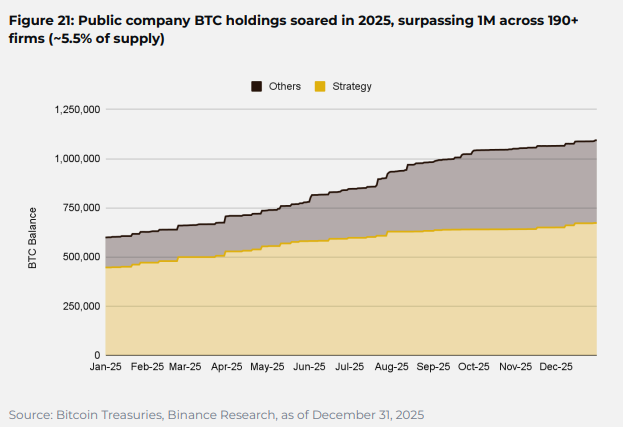
Capital allocators are integrating this distributed backup concept into core operations. Binance Research reported that US spot Bitcoin ETFs accumulated over $21 billion in net inflows. Corporate treasuries now also hold 1.1 million Bitcoin—roughly 5.5% of the total supply.
Binance’s EOY dataconfirms this shift. The company’s figures show a 21% YoY growth in institutional trading volume and a 210% surge in OTC fiat trading.
Standard Chartered projects that tokenized real-world assets willreach a $2 trillion valuation by 2028—with the vast majority settling on Ethereum. Partnerships with BlackRock and Franklin Templeton indicate traditional finance is moving from experimentation to integration. State Street survey data shows that 86% of institutional investors report having the infrastructure readiness required for adoption.
From Speculative Assets to Real-World Infrastructure
Network utility is expanding to validate Stornetta's broader technological vision. "We've started to see the movement of real assets, physical assets onto the blockchain so that this notion of digital assets is now broadened to not just be in the speculative cryptocurrencies, but also into real assets that are now more efficiently able to be processed on blockchain," Stornetta noted.
Decrypt reported that Bhutan plans to anchor its national digital identity system on Ethereum by early 2026. Stornetta highlighted successful blockchain implementations for secure land registries and election balloting integrity in Latin America. McKinseydetailed how tokenized cash enables next-generation settlement platforms. A Chainalysis report found that agentic payments are becoming usable at internet scale, processingover 100 million autonomous transactions.
The Path to Invisibility
Stornetta's work directly supports the impending invisibility era of cryptocurrency. He views blockchain as a trusted underlayer that global populations will rely upon without recognizing its mechanics. This distributed trust model will eventually make deep fakes irrelevant by applying cryptographic verification beyond standard finance. Verified digital identity becomes essential as autonomous AI agents execute transactions silently.
Winning technologies embed themselves into daily life by hiding infrastructure, and crypto succeeds when it runs in the background. And mass adoption does not look like a revolution led by people waving private keys. It looks like a quiet migration to better tools.
The Underlayer Nobody Sees
Bitcoin introduced a fundamental shift by utilizing decentralization as a structural foundation. The most secure database is ultimately the one operating as its own global backup system. As institutions absorb these operational fundamentals, digital asset adoption will scale organically.
Blockchain technology is rapidly moving toward achieving the exact milestone the internet reached decades ago, securing complete invisibility through absolute global ubiquity.
Bleiben Sie auf dem Laufenden über CoinCarp Social Media und diskutieren Sie mit uns:
X (Twitter) | Telegram | Reddit
CoinCarp App jetzt herunterladen: https://www.coincarp.com/app/