
Fiat currencies
Crypto Currencies
No results for ""
We couldn't find anything matching your search.Try again with a different term.
Gold Price Prediction: Can Dollar Weakness and Fed Policy Push Gold Toward $5,000?
 Leo Henry 25-08-2026 14:38:34
  Gold Price Prediction: Can Dollar Weakness and Fed Policy Push XAU Toward $5,000?
 Gold is approaching another important test after climbing to a three-month high before retreating toward $4,640. Rather than signaling an obvious end to the recovery, the pullback comes as the metal remains supported by softer Treasury yields, a weaker U.S. dollar and renewed concerns about the country's fiscal position.
The next phase of the rally could depend less on gold itself and more on the macro environment surrounding it. Federal Reserve Chair Kevin Warsh's Jackson Hole speech and upcoming U.S. PCE inflation data could reshape expectations for interest rates, while recent Treasury actions have revived the debate around government debt and currency debasement. Against that backdrop, the longer-term gold price prediction is becoming increasingly tied to whether investors continue rotating toward hard assets as protection against monetary and fiscal uncertainty.
Falling Yields Give Gold Another Tailwind
Gold's latest advance has coincided with a notable shift in the bond and currency markets. Spot gold recently reached its highest level in more than three months before easing 0.2% to around $4,640.39, while U.S. gold futures remained close to $4,696.
Long-term Treasury yields have declined following plans by the U.S. Treasury to increase liquidity-support buybacks of longer-dated government securities. The dollar has weakened alongside yields, with the dollar index trading near 98.96 during Tuesday's Asian session.
Both developments are potentially favorable for precious metals. Gold produces no yield, meaning declining bond yields can reduce the relative disadvantage of holding the metal. A weaker dollar can also make dollar-denominated gold more attractive to international buyers.
The sustainability of those conditions is now the bigger question. Markets are preparing for U.S. PCE inflation data alongside Warsh's first Jackson Hole address as Fed chair. Persistent inflation could reinforce expectations that interest rates need to remain elevated, potentially limiting gold's upside. A softer inflation picture or less hawkish Fed message would give bulls a stronger macro foundation for extending the rally.
$4,700 Becomes the First Major Test for Gold Bulls
The short-term chart presents a clear dividing line between consolidation and another breakout attempt. Gold recently retreated after challenging the $4,680 to $4,700 region, putting immediate attention on whether buyers can absorb the pullback.
The first significant demand zone sits around $4,615 to $4,623. Forex Expertise identifies this region as an intraday liquidity and reaction area, making it an important level for determining whether the latest decline remains a routine retracement.
If support holds, the first recovery target sits around $4,658 to $4,668. Above that, liquidity around $4,680 to $4,692 could bring gold back toward the more consequential $4,700 to $4,712 resistance band.
A sustained move above $4,712 would represent an important technical development. Acceptance above that level would weaken the immediate bearish setup and suggest that buyers are prepared to resume the recovery toward higher levels.
Failure to defend $4,615 would instead expose the $4,588 to $4,597 region, followed by stronger demand around $4,558 to $4,568. A decisive breakdown below $4,558 would raise the probability that gold is entering a broader correction rather than simply consolidating beneath resistance.
Kiyosaki's Dollar Warning Adds to the Hard-Asset Case
The macro argument for owning gold has also received renewed attention after Robert Kiyosaki criticized the Treasury's expanded bond-buyback program. The Rich Dad Poor Dad author argued that government policy continues to weaken the purchasing power of the dollar and reiterated his preference for scarce assets including gold, silver and Bitcoin.
The Treasury is increasing the maximum size of liquidity-support buybacks in the 10-to-20-year and 20-to-30-year sectors from $2 billion to at least $4 billion per operation. The program is intended to improve liquidity in longer-dated government securities following strong participation from market makers.
Treasury buybacks are not equivalent to Federal Reserve quantitative easing. They involve exchanging existing government debt rather than directly expanding the monetary base. Still, their expansion arrives while U.S. federal debt has exceeded $40 trillion and long-term borrowing costs remain an increasingly prominent concern for investors.
That backdrop helps explain why the debasement argument continues to resonate even when the technical comparison with QE is imperfect. If government borrowing requirements remain elevated and investors become increasingly concerned about the long-term purchasing power of fiat currencies, gold could continue benefiting as a defensive asset.
Gold's Weekly Chart Still Favors the Bulls
Short-term volatility has not materially damaged gold's broader technical structure. COMEX gold futures recently traded around $4,693, leaving the market comfortably above its 50-week exponential moving average near $4,278.
Weekly RSI around 59.7 is also constructive. The indicator has recovered above the neutral 50 threshold but remains below levels normally associated with an excessively overbought market. That suggests momentum has strengthened without yet reaching an obvious technical extreme.
The setup is particularly relevant following gold's earlier correction from above $5,000. Rather than collapsing toward long-term support, the metal has rebuilt momentum while maintaining a substantial cushion above its rising 50-week average.
TD Securities remains constructive on gold but has cautioned that its $5,350 target may still be premature if inflation keeps interest rates elevated. That distinction captures the current setup well. Gold's long-term structure remains bullish, but another major move higher may require the macro environment to cooperate.
CoinCodex Gold Price Prediction Points to Strong Late-2026 Rally
According to the latest CoinCodex gold price prediction, the current consolidation could eventually give way to a much stronger advance during the final months of 2026. The model expects August to remain comparatively restrained, with gold averaging around $4,792 and potentially reaching approximately $4,890.
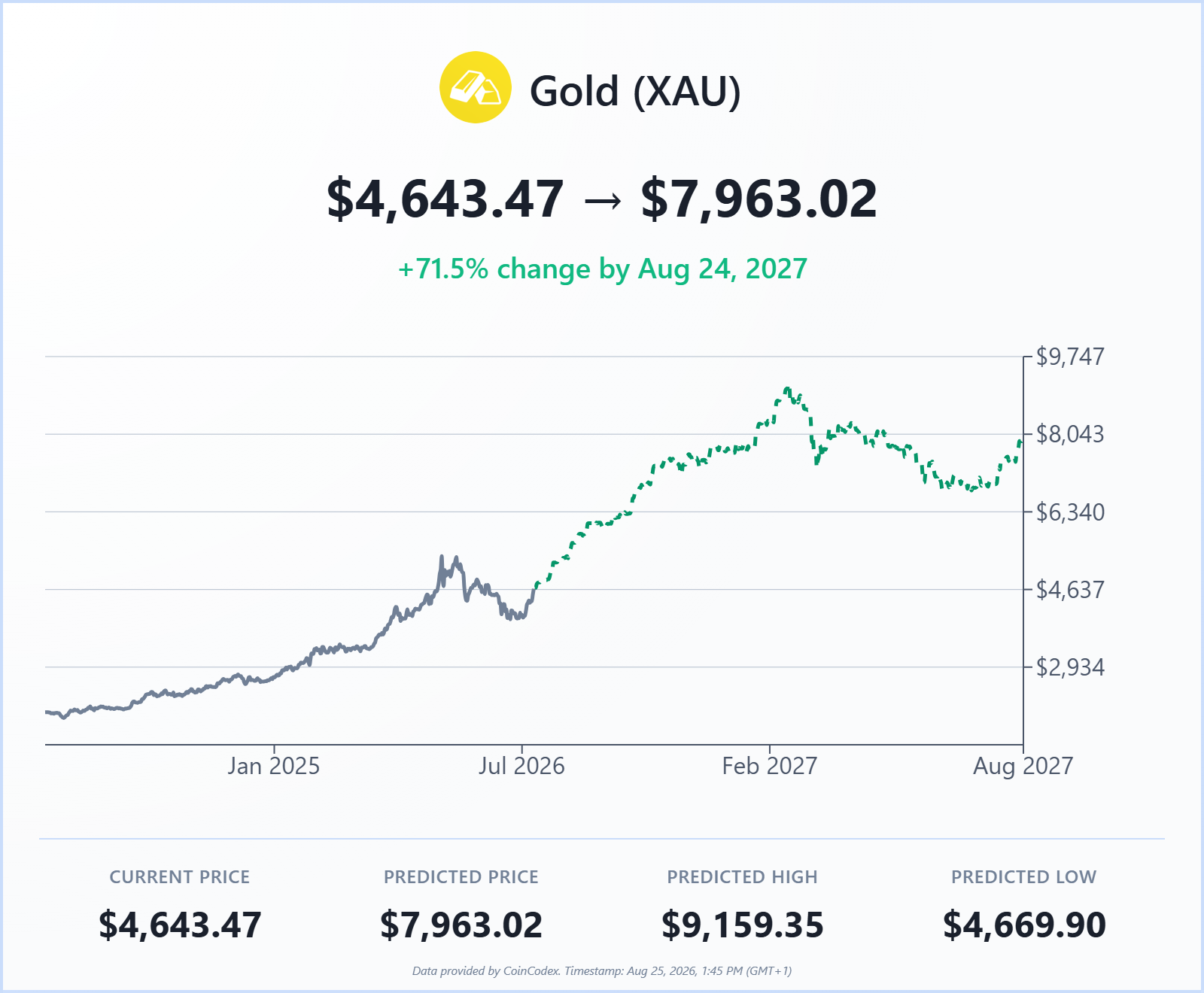
The projected trend accelerates sharply after that. September's average moves to roughly $5,376, taking gold comfortably beyond its previous $5,000 milestone, while October's average rises above $6,100. The upper end of the October forecast approaches $6,356, implying that CoinCodex expects momentum to strengthen substantially if gold successfully exits its current consolidation.
November and December represent the strongest portion of the 2026 forecast. The model puts November's average near $6,970, with a potential high around $7,527. December then carries an average projection of approximately $7,434 and a maximum near $7,631.
The forecast remains bullish into early 2027. January's average moves above $7,700 before February climbs to approximately $8,392. The most aggressive target arrives in March, when CoinCodex sees the possibility of gold reaching roughly $9,234, representing close to a doubling from the model's reference level.
Momentum is projected to cool after the first quarter. Average prices decline toward $8,090 in April, $7,850 in May and $7,231 in June before dropping just below $7,000 in July. A recovery toward an average of roughly $7,566 is then projected for August 2027.
This trajectory is notably more aggressive than the immediate technical picture. It effectively assumes that gold will break through $5,000, establish a substantially higher trading range and maintain strong safe-haven demand into 2027. Fed policy, inflation, real yields and dollar performance will determine whether those conditions emerge.
Can Gold Return Above $5,000?
The path toward $5,000 begins with a much smaller technical battle. Gold first needs to defend the $4,615 to $4,623 area and establish a sustained move above $4,700 to $4,712. Clearing that resistance would strengthen the recovery and bring the previous highs back into focus.
Warsh's Jackson Hole speech could become the catalyst that determines which side gains control. A less hawkish policy message combined with softer inflation, lower Treasury yields and continued dollar weakness would create a favorable backdrop for another gold advance. Persistent inflation and renewed upward pressure on yields could delay that scenario and expose lower support levels.
For now, the weekly chart still favors buyers and the macro case for hard assets remains intact. CoinCodex's targets above $7,000 in late 2026 and potentially $9,000 in early 2027 are considerably more aggressive than conventional institutional forecasts, but gold does not need to reach those levels for the bullish thesis to remain valid. The more immediate confirmation would come from turning $4,700 resistance into support and putting $5,000 back within reach.

Most Read News


Related Articles
-
 Bitcoin price battles $80K as major altcoins post double-digit losses: Market watch
 - Bitcoin ETFs Snap Two-Week Losing Streak Despite Late-Week Slide
- 3 Stocks to Watch This Week as Earnings Season Hits Crypto
 BeInCrypto 30 mins Ago
 - UK banks draw 10,092 crypto complaints as payment limits face scrutiny
 crypto.news 51 mins Ago
 Bitcoin price battles $80K as major altcoins post double-digit losses: Market watch

 Bitcoin ETFs Snap Two-Week Losing Streak Despite Late-Week Slide
 3 Stocks to Watch This Week as Earnings Season Hits Crypto
  UK banks draw 10,092 crypto complaints as payment limits face scrutiny