
Fiat currencies
Crypto Currencies
No results for ""
We couldn't find anything matching your search.Try again with a different term.
Silver Price Prediction: Can Supply Deficits Overpower JPMorgan’s $63 Outlook?
 Leo Henry 25-08-2026 16:34:59
  Silver Price Prediction: Can Supply Deficits Overpower JPMorgan’s $63 Outlook?
 Silver is trading near $68 after renewed selling interrupted its latest recovery, but the bigger question facing investors is whether the pullback reflects weakening fundamentals or another consolidation within the broader precious-metals rally. Spot silver recently fell 1.3% to around $68.01 as traders prepared for U.S. inflation data and Federal Reserve Chair Kevin Warsh’s Jackson Hole speech.
The outlook is unusually divided. JPMorgan expects silver to trade around $63 during the fourth quarter of 2026 as physical-market tightness eases, yet the Silver Institute still estimates a 40.3 million-ounce supply deficit this year. The latest silver price prediction from CoinCodex is far more bullish, projecting that the metal could cross $100 later in 2026 if the current correction gives way to another major advance.
Interest Rates Return to Focus as Silver Retreats
Silver's latest decline comes after falling long-term Treasury yields and a softer U.S. dollar provided support for precious metals. Those tailwinds have not disappeared, but investors are becoming more cautious ahead of two events that could reshape expectations for U.S. monetary policy.
The first is upcoming U.S. inflation data. Persistent price pressures would make it harder for the Federal Reserve to shift toward easier monetary conditions, potentially keeping yields elevated and weighing on non-yielding assets. Warsh's Jackson Hole address could then provide additional clues about how the Fed views inflation and interest rates.
Silver is particularly sensitive to this combination because its price reflects both investment demand and industrial consumption. A softer policy backdrop could strengthen investor demand while supporting broader economic activity, whereas higher-for-longer rates would make the immediate recovery more difficult.
That leaves the metal vulnerable to macro-driven volatility even though its underlying supply picture remains tight. Silver may need a favorable shift in rates and the dollar before structural fundamentals become the dominant price driver again.
JPMorgan Takes a Cautious View on Silver
J.P. Morgan Global Research expects silver to reach approximately $63 an ounce in the fourth quarter of 2026, with the bank forecasting an average price near $70 for the full year. The revised outlook represents a substantial downgrade from its previous expectations.
One reason is that some of the extreme physical-market tightness that previously supported silver prices has begun to ease. JPMorgan also sees softer industrial demand in certain markets and the possibility of elevated global interest rates as potential constraints on another large rally.
The $63 target would represent a meaningful decline from current levels, but it would not necessarily destroy silver's longer-term technical structure. The metal's 50-week exponential moving average currently sits near $63.93, almost exactly where JPMorgan expects prices to move during the fourth quarter.
That creates an important convergence between the fundamental and technical outlooks. A decline toward $63 to $64 could represent a major test of the broader recovery rather than confirmation of a prolonged bear market.
Five-Year Supply Deficit Challenges the Bearish Case
While JPMorgan sees physical-market conditions becoming less restrictive, silver remains in a structural supply deficit. The Silver Institute's World Silver Survey 2026 estimates that demand will exceed supply by 40.3 million ounces this year.
It would be the fifth consecutive annual deficit for the silver market. Repeated shortfalls have been one of the central fundamental arguments behind higher prices, particularly as industrial applications compete with investment demand for available supply.
The deficit does not guarantee that silver prices will rise immediately. Interest rates, currency movements and investor positioning can dominate physical-market fundamentals for extended periods. Softer industrial demand could also reduce some of the pressure created by constrained supply.
Still, five consecutive deficits make the longer-term outlook more complicated than JPMorgan's $63 target alone suggests. If investment demand strengthens at the same time that supply remains insufficient, silver could quickly become more sensitive to renewed buying.
$68.50 Could Determine the Next Short-Term Move
Technical conditions currently favor caution. Silver has attempted to rebound following a sharp decline, but resistance around $68.38 to $68.51 is preventing buyers from establishing clear control.
A short-term chart from Eagle Pips Pro places the primary reaction area near $68.38. With silver recently around $68.04, the metal is close enough to resistance for the next move to provide a useful indication of market direction.
A rejection between $68.38 and $68.51 would preserve the immediate bearish setup. In that scenario, attention could shift back toward approximately $66.96 as the next downside target.
A sustained break above $68.51 would change the picture. Buyers would have reclaimed the immediate breakdown area, making $70 the next important level. Establishing support above $70 would provide considerably stronger evidence that the latest sell-off has run its course.
Long-Term Silver Trend Has Not Broken Yet
The weekly chart remains stronger than the short-term setup suggests. COMEX silver futures recently traded around $68.04, still several dollars above the 50-week exponential moving average near $63.93.
Weekly RSI around 51.1 has recovered just above the neutral 50 level. The reading does not signal particularly strong bullish momentum, but it indicates that the broader market has not shifted decisively into bearish territory either.
This leaves silver between two important areas. The $68.38 to $70 region represents the first obstacle for buyers, while the 50-week average around $63.93 provides a much more significant line of defense if the correction deepens.
The proximity of that moving average to JPMorgan's $63 forecast makes the mid-$60s particularly important. Holding the area during another decline could establish a stronger long-term base. Losing it would make the bank's cautious outlook considerably more significant from a technical perspective.
CoinCodex Silver Price Prediction
According to the latest CoinCodex silver price prediction, silver could stage a sharp rally into the end of 2026, contrasting strongly with JPMorgan's more cautious fourth-quarter outlook. August remains relatively restrained, with an average forecast near $70.72 and a high around $72.49, before momentum is projected to accelerate in September. The September average rises to roughly $84.02, with the upper target reaching $96.27.
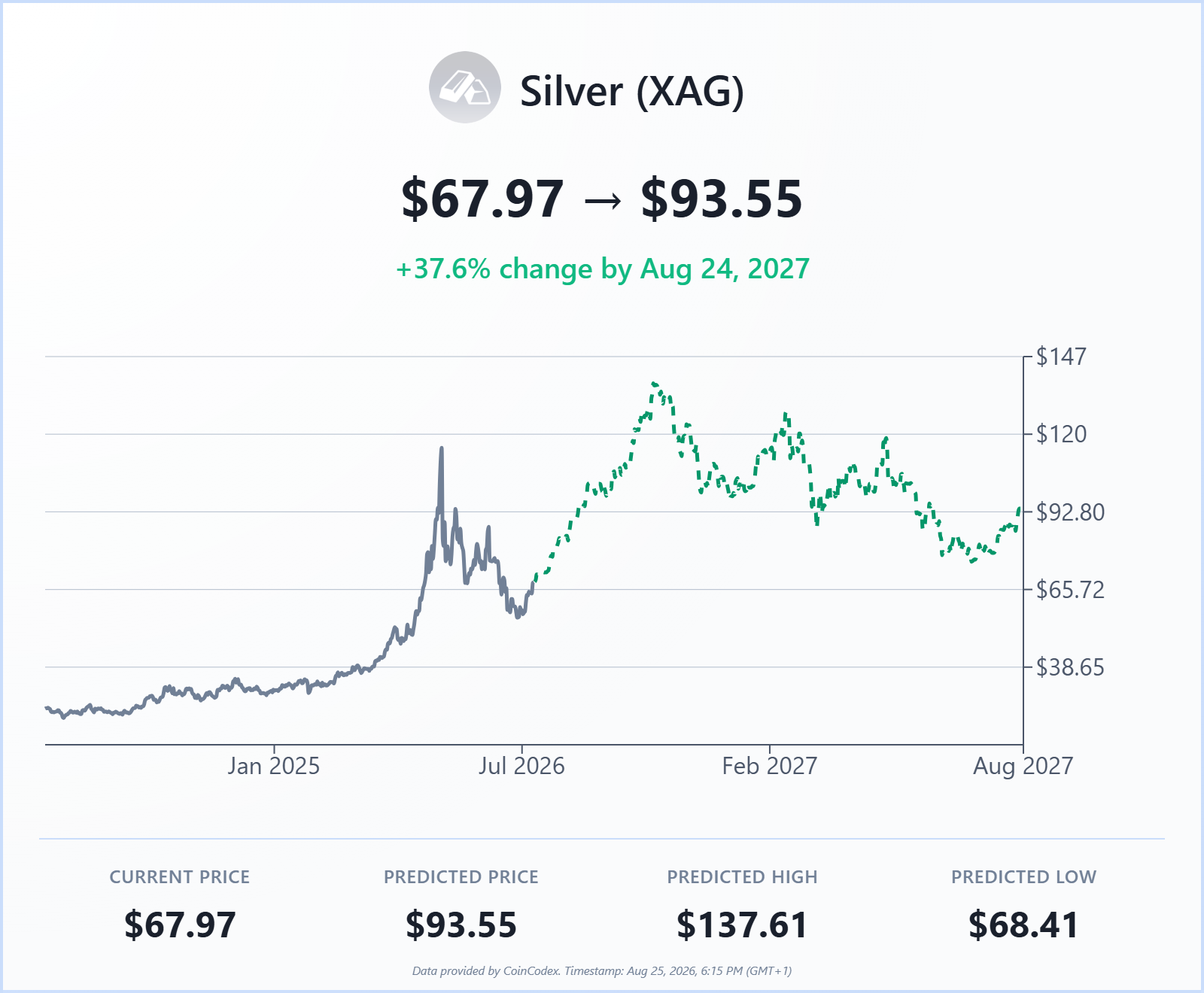
The forecast becomes considerably more bullish in October and November. Silver is projected to average about $102.82 in October before climbing to $125.80 in November, when the model sees a potential high of $137.81. That peak would represent roughly 101% upside from the model's reference price. December remains elevated with an average near $116.47, although the wider projected range suggests volatility could increase following the rally.
CoinCodex expects that momentum to cool during 2027 rather than continue at the same pace. Average prices remain above $100 from January through May, including a rebound toward $114.12 in February, while March carries a particularly wide range between roughly $87 and $128. This suggests silver could retain much of its projected late-2026 advance while experiencing substantially larger price swings.
The more pronounced correction is projected for the summer, with average prices falling toward $89.59 in June and $79.91 in July before recovering to around $88.70 in August 2027. Overall, the model points to its strongest upside between September and November 2026, followed by a volatile consolidation rather than a continued straight-line rally.
Can Silver's Supply Deficit Drive Another Rally?
Silver's next major move may ultimately depend on whether its structural supply deficit can overcome the pressure created by interest rates and normalizing physical-market conditions. Five consecutive annual deficits provide a strong fundamental argument for the metal, but JPMorgan's $63 target shows that institutional analysts are not convinced scarcity alone will keep prices elevated.
The first test is considerably closer. Silver needs to move through $68.38 to $68.51 before challenging $70, while failure to regain momentum could bring $66.96 and eventually the $63 to $64 long-term support region into play.
CoinCodex's forecast above $100 represents a far more aggressive scenario and would require silver to break decisively out of its current range. If inflation cools, Treasury yields remain under pressure and investment demand returns while the physical market stays in deficit, conditions for that breakout would become more favorable.
Until then, $70 and the 50-week average near $63.93 define the two sides of the current outlook. A breakout above the former would strengthen the bullish case, while losing the latter would give JPMorgan's more cautious forecast considerably more weight.

Most Read News


Related Articles
-
 Bitcoin price battles $80K as major altcoins post double-digit losses: Market watch
 - Bitcoin ETFs Snap Two-Week Losing Streak Despite Late-Week Slide
- 3 Stocks to Watch This Week as Earnings Season Hits Crypto
 BeInCrypto 30 mins Ago
 - UK banks draw 10,092 crypto complaints as payment limits face scrutiny
 crypto.news 51 mins Ago
 Bitcoin price battles $80K as major altcoins post double-digit losses: Market watch

 Bitcoin ETFs Snap Two-Week Losing Streak Despite Late-Week Slide
 3 Stocks to Watch This Week as Earnings Season Hits Crypto
  UK banks draw 10,092 crypto complaints as payment limits face scrutiny