
Fiat currencies
Crypto Currencies
No results for ""
We couldn't find anything matching your search.Try again with a different term.
Why Stablecoins Are Becoming the Settlement Layer for Traditional Finance
 Leo Henry 22-07-2026 07:47:28
 Why Stablecoins Are Becoming the Settlement Layer for Traditional Finance
 TradFi-linked perpetuals now account for roughly 10% of stablecoin trading volume. With total supply above a $320 billion market capitalization and transaction volume reaching$33 trillion in 2025, approaching three times Visa's annual throughput, even 10% represents significant settlement flow.
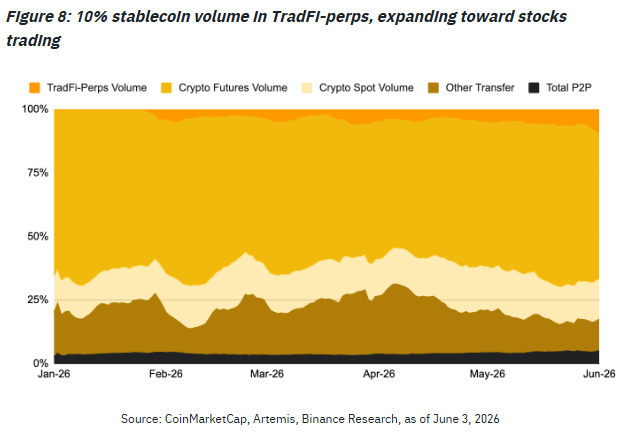
This volume actively settles commodity perpetuals, equity-linked derivatives, direct stocks, and pre-IPO contracts. Stablecoins are steadily transitioning from decentralized finance utilities into the settlement layer for traditional assets.
From Trading Token to Settlement Rail
The ECB's Christine Lagarde recently identified a functional shift. In a May 2026 speech, she noted stablecoins perform two distinct functions today: extending reserve currency reach and acting as the settlement asset for tokenized financial infrastructure. Lagarde observed they have become "the default cash leg" for atomic settlement, the simultaneous exchange of two assets within a single transaction.
The advantages of this structure become clear when examining costs. Stablecoin transfers on Layer 2 networks or Solana cost under $0.10 and settle in seconds. In contrast, ACH transfers take one to three business days, SWIFT ranges from $25 to $50, and card networks settle in one to three days. For a business processing $1 million in monthly revenue, card delays lock approximately $67,000 in working capital. With stablecoin settlement, that frozen capital drops to zero.
"The growth we're seeing across commodities and equities reflects a broader shift in how investors access global markets."
—Shunyet Jan, Head of Spot & Derivatives at Binance
The market infrastructure he describes relies heavily on stablecoin settlement. Furthermore, Binance Research notes stablecoins can eliminate an average 3.6% and roughly $40 per transaction in cross-border off-ramp costs.
What TradFi Products Are Being Settled in Stablecoins
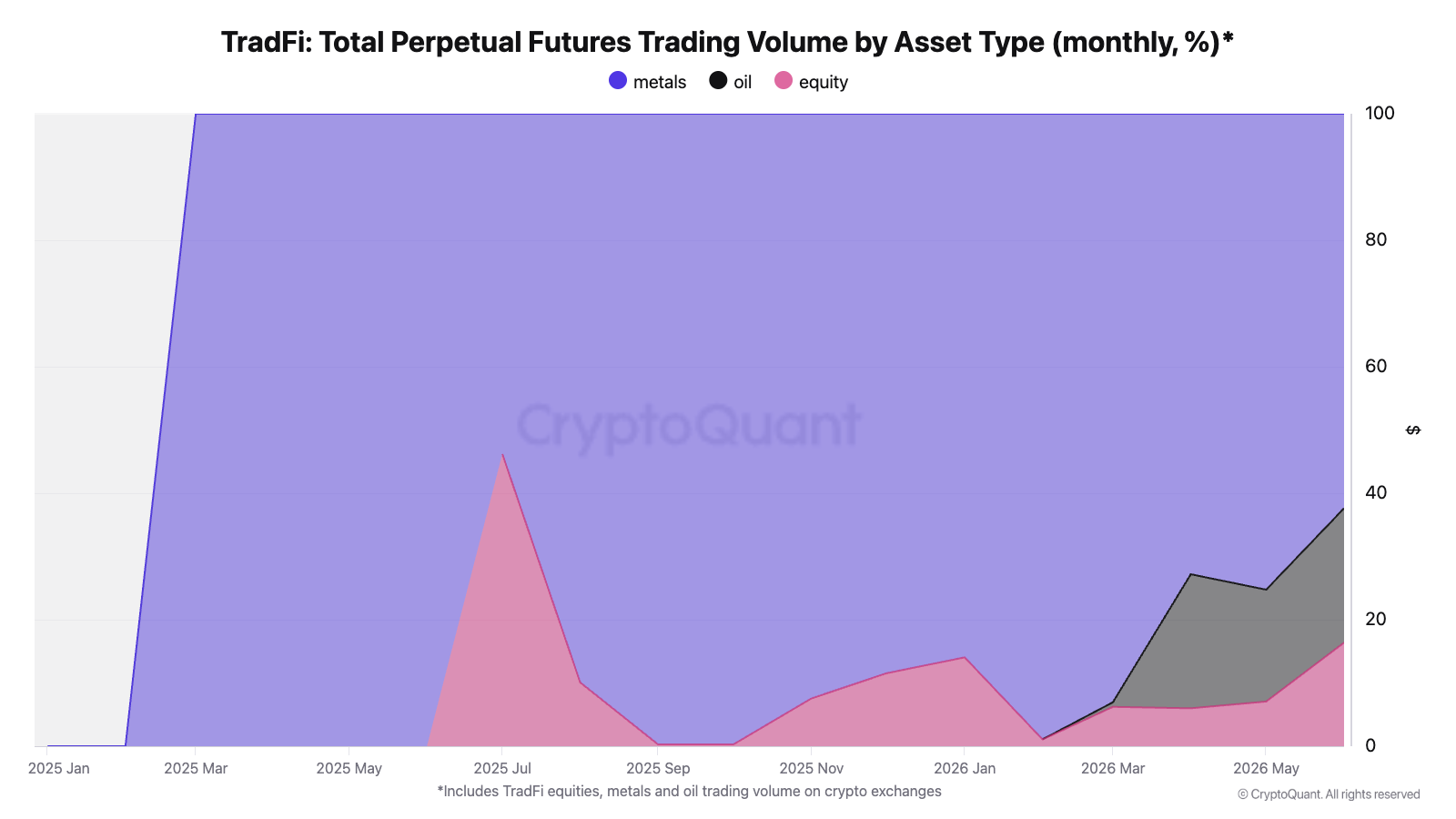
Product categories reveal what drives this settlement activity. Based on CryptoQuant data, commodity perpetuals processed $83 billion in April 2026, comprising 81% of traditional finance perpetual volume. Equity-linked perpetuals peaked at $34 billion in March, while pre-IPO perpetuals surged from $2 million in March to $12 billion in June. All are margined and settled using stablecoins.
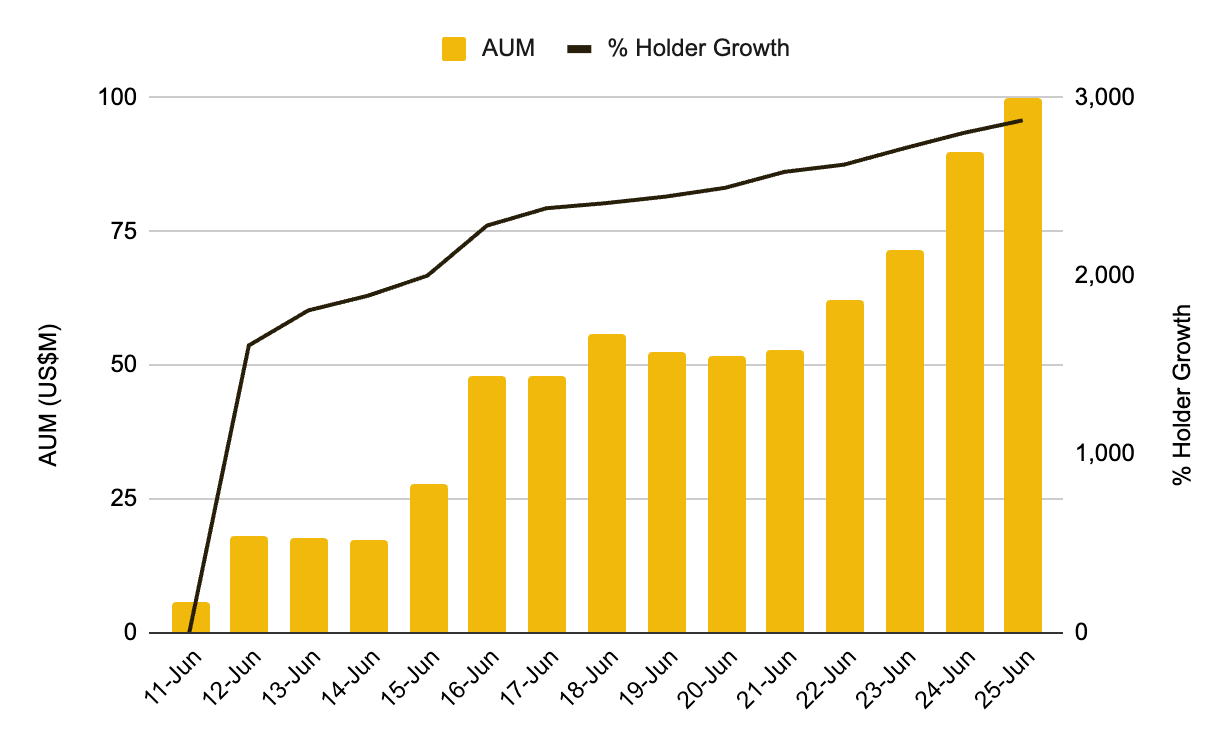
Direct stock trading follows similar patterns. Binance's bStocks crossed $100 million in assets within 15 days, generating $458 million in cumulative volume through stablecoin infrastructure. Data shows 58% of this volume originated in emerging markets, where stablecoins eliminate the foreign exchange conversion step that adds cost to accessing dollar-denominated assets.
This transition extends into traditional infrastructure. SG-FORGE's EUR and USD CoinVertible are embedded into Clearstream via a partnership with Deutsche Börse Group to handle collateral management and settlement. Deutsche Börse's Jens Hachmeister called these stablecoins "reference products in Europe because they are regulated, have gained traction and create a bridge between traditional finance and decentralized finance."
The Regulatory Frameworks Taking Shape
The 10% volume share may accelerate as regulatory frameworks solidify. In the United States, the GENIUS Act requires 1:1 reserve backing with liquid assets, monthly third-party attestations, and AML/KYC compliance. A State Street analysis notes the legislation "creates a clear regulatory framework for dollar-backed payment stablecoin issuers" and suggests "both fintech and traditional financial companies could benefit from the regulatory clarity." A Federal Reserve note observed that introducing payment stablecoins "could have a far-reaching effect on the financial system."
In Europe, the Markets in Crypto-Assets (MiCA) transitional period ends July 1, 2026, regulating asset-referenced and electronic money tokens with strict transparency requirements.
However, structural questions persist. The BIS Annual Economic Report 2026 observed that "current stablecoin designs fall short in terms of the key properties that ensure trust in money—in particular singleness." The ECB's Lagarde cautioned that stablecoins "can break away from their peg during times of stress" and lack unconditional finality. Emerging regulatory frameworks are designed precisely to address these weaknesses.
From 10% to a Settlement Standard
If traditional finance usage captures a larger share of stablecoin volumes, the implications stretch beyond crypto exchanges. The Federal Reserve noted payment stablecoins could "potentially disrupt the correspondent banking model" by lowering the institutional cost of cross-border finance. Industry data from Elliptic highlights that "stablecoins processing $46 trillion in transaction volumes rivaling Visa and PayPal [in 2025]." The company projects this convergence "will accelerate" in 2026.
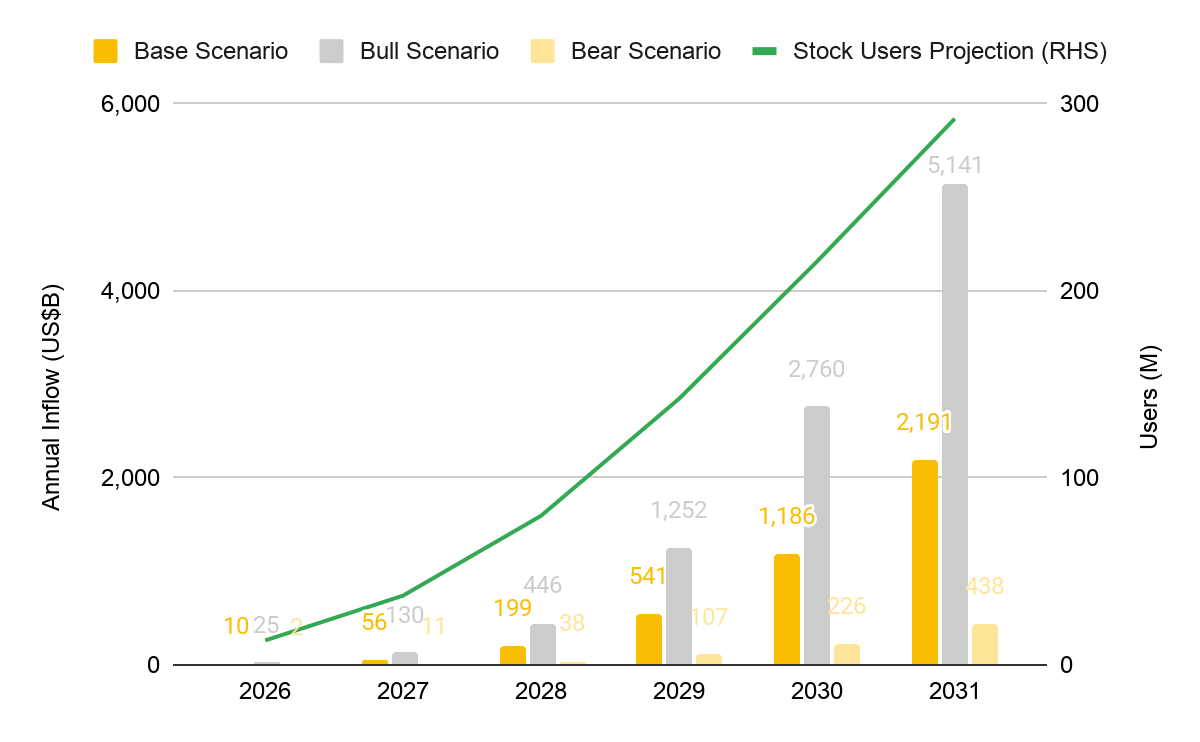
Crypto exchanges could channel $2 trillion in incremental capital and 300 million new investors into equity markets by 2031. If a fraction of that capital settles in stablecoins, the 10% figure becomes a historical footnote rather than a ceiling.
Stablecoins started as the internal currency of crypto markets. The 10% TradFi linkage suggests they may be growing into a general-purpose settlement layer. Whether they reach that scale depends on regulatory clarity, institutional adoption, and whether the settlement advantages hold under stress.

Most Read News


Related Articles
-
 Bitcoin price battles $80K as major altcoins post double-digit losses: Market watch
 - Bitcoin ETFs Snap Two-Week Losing Streak Despite Late-Week Slide
- 3 Stocks to Watch This Week as Earnings Season Hits Crypto
 BeInCrypto 30 mins Ago
 - UK banks draw 10,092 crypto complaints as payment limits face scrutiny
 crypto.news 51 mins Ago
 Bitcoin price battles $80K as major altcoins post double-digit losses: Market watch

 Bitcoin ETFs Snap Two-Week Losing Streak Despite Late-Week Slide
 3 Stocks to Watch This Week as Earnings Season Hits Crypto
  UK banks draw 10,092 crypto complaints as payment limits face scrutiny