
Tiền pháp định
Các loại tiền điện tử
Không có kết quả cho ""
Chúng tôi không thể tìm thấy bất cứ thứ gì trùng khớp với tìm kiếm của bạn.Hãy thử lại bằng một cụm từ khác.
Q1's Sell-Off Revealed Which Crypto Exchanges Traders Actually Trust
The crypto market had a rough Q1 with statistics showing significant exchange outflows as well as reductions in overall volume. One culprit for the selloff is the widely cited tariff panic of late 2025. While these movements have likely caused traders to have a few sleepless nights, this situation also presents an opportunity to analyze trader behavior. One data point was which exchange retained trader trust the most. This can be determined by watching where the liquidity, reserves and trading volume went. That answer, based on available data, is Binance.
Trader actions tell the story
In a Cointelegraph piece that was shared on MSN, the data shows that "a small group of exchanges continue to dominate crypto derivatives" which represent the vast majority of total market volume. Binance alone handled $4.9 trillion in derivatives volume alongside $640 billion in spot volume "or roughly 35% of activity among the top 10 exchanges."
This concentrating at the top trend is telling us that traders are seeking safety and security, avoiding smaller platforms that may be struggling during events like the Q1 downturn. The other story this tells us is that the moves may be related to liquidity seeking. As derivatives now represent the majority of all market volume, this tells us that institutional investors are making up a significant portion of the overall market volume.
Binance Co-CEO Richard Teng framed this shift as a clearer view into how liquidity and price discovery function in a normalized market, noting, "As trading activity normalized in Q1, market structure became clearer: derivatives continued to lead price discovery, while liquidity consolidated on platforms able to support scale. In a lower-volume environment, Binance’s consistent leadership across both spot and perpetual markets reflects the value users place on deep liquidity and reliable execution."
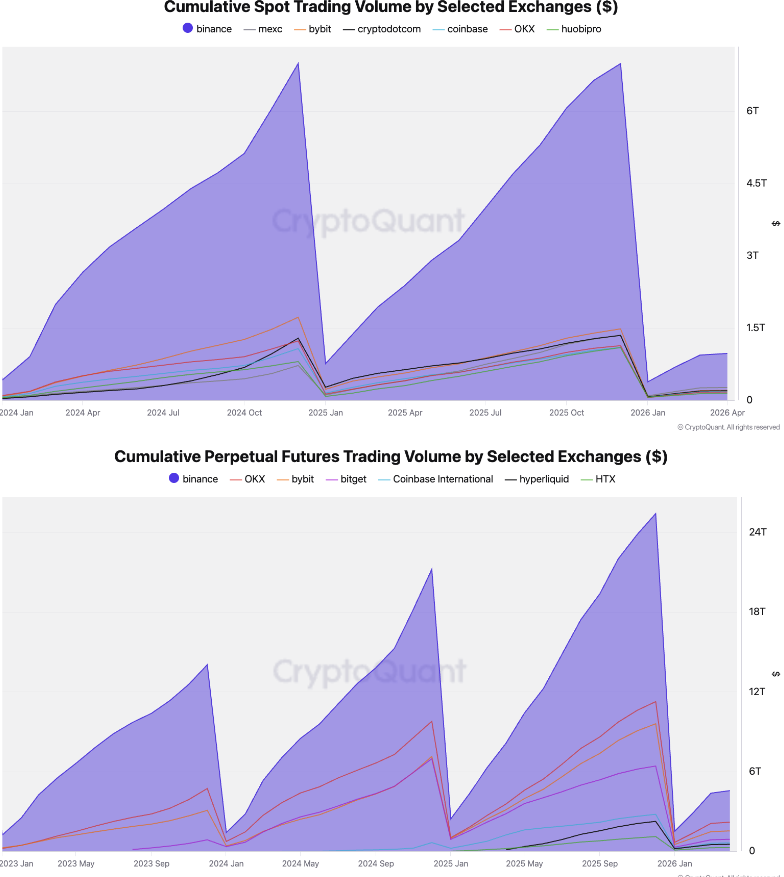
Professional investors of this size require larger pools of liquidity. As such, during a downturn where market liquidity can dry up, it is logical that they would do the majority of their business on platforms that have enough liquidity to support their moves. In the case of Q1 2026, their platform of choice was clearly Binance, according to the data.
Reserves reveal where traders put their trust
Volume is an important metric to consider as it shows us where activity is happening. However, it does not tell us which platforms users put their trust in. Traders can easily make trades on a platform, then withdraw everything and leave. That type of action can show exchange volume, but it doesn’t demonstrate confidence in the platform itself. This is why we must consider exchange reserves and how they stack up compared to volume. Simply put, traders won’t leave capital on platforms that they don’t trust.
According to the Coinglass Q1 2026 market share report, Binance "user asset reserves were approximately $152.9 billion, accounting for about 73.5% among major CEXs." If nearly three-quarters of all asset reserves are being held on Binance, this is an unavoidable signal that the market has decided where it wants to park its capital. The next largest competitor maintained $10 billion in asset reserves, a noticeably smaller fraction of what Binance carries.
What the downturn tested
The Cointelegraph piece on MSN contains a key insight to the theme of Q1. The author wrote that Q1 was "about recovery, concentration, and shifting market structure." The keywords there are concentration and shifting structure.
Strong market swings typically lead to traders becoming more conservative. Instead of seeking profit, many may take on a defensive position. This risk-off behavior means volume tends to go down and exchanges experience capital outflows. This is not the same as panic-driven sell offs. The market has undergone a significant shift from being primarily spot trading activity as that is more the domain of retail investors. Instead, the market is now mostly derivatives volume, meaning institutional activity.
Tìm chúng tôi trên:
X (Twitter) | Telegram | Reddit
Tải xuống ứng dụng CoinCarp ngay bây giờ: https://www.coincarp.com/app/
- Paybis Crypto Platform Overview Sơ cấp 4m
- 11 Best Bitcoin & Crypto Plinko Sites With Bonuses in 2026 Sơ cấp 17m
- Dexsport Casino Review: Casino Games and Sports Betting with Privacy and Crypto-Friendly Features Sơ cấp 7m
- 13 Best Crypto Sports Betting Sites in Australia 2026 (AFL, NRL, Cricket & More) Sơ cấp 17m